
Mega trailer dimensions vs standard trailer: height, volume and when the extra height pays
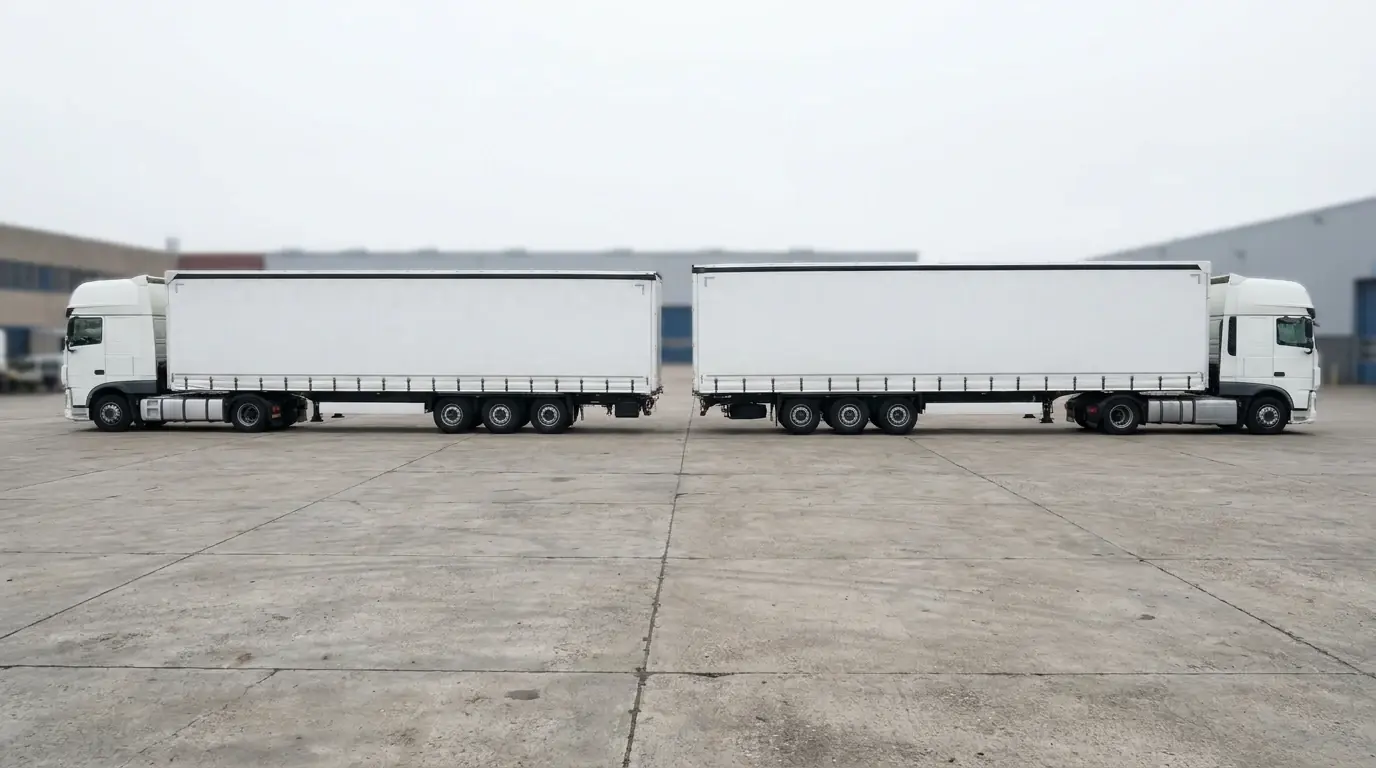
A mega trailer differs from a standard curtainsider in the one dimension that matters for loading: inside height. The floor is the same, 13.62 m by 2.48 m inside on the Cargobull S.CS Mega and S.CS Universal pages, so a load takes the same loading metres (LDM) in either. Cargobull lists up to 3,200 mm inside height for the Mega and up to 3,050 mm for the Universal, both "depending on the coupling height". Our planner's presets are 2.70 m for a standard body and 3.00 m for a mega, about 91 m³ against 101 m³ (inside length x width x height, no allowance for roof beams). The extra height pays only when your pallets gain a layer, and the height bands where that happens are in the table further down.
Same floor, same LDM
A single-layer load needs the same metres in either body, so a mega does not shorten a flat load. On a 13.6 m deck the ceiling is 34 euro pallets (1200 x 800 mm) at 0.4 m each, which our planner reaches by mixing lengthwise and turned rows; the loading metre table gives LDM per pallet and the 33-or-34 question.
The figures below are as each source publishes them. The makers measure height in different places, so the column says which height each number is.
| Trailer (source) | Inside length x width (mm) | Height as published (mm) | Tractor coupling height (mm) |
|---|---|---|---|
| Cargobull S.CS Universal | 13,620 x 2,480 | inside height up to 3,050 | not listed |
| Cargobull S.CS Mega | 13,620 x 2,480 | inside height up to 3,200 | not listed |
| Krone Profi Liner 4 CS (krone-trailer.com) | 13,620 x 2,480 (side access) | side access 2,600-2,700 | 1,030-1,250 |
| Krone Mega Liner, 50 mm neck (krone-trailer.com) | 13,620 x 2,480 (side access) | side access 2,860; 3,000 internal height "for automotive boxes" (product page: "UK, roof beam") | 915 |
| Kögel Mega | 13,620 | 3,000 ("three meters throughout") | not listed |
| DSV mega trailer | 13.62 m x 2.48 m | 2,940, "100 m3" | not listed |
Compared like for like, Krone's side access height rises from 2,600-2,700 mm on the Profi Liner to 2,860 mm on the Mega Liner, 16 to 26 cm more for full-width loading. Krone gives the 3,000 mm figure as the internal height suitable for automotive boxes, and its product page marks it "UK, roof beam", so it is not clear height everywhere in the body.
Cargobull footnotes its figures "depending on the coupling height and the statutory conditions". DSV says most of its mega trailers have a height of 3 metres with a raisable top cover, but its table lists 2.94 m and notes that dimensions vary by manufacturer and production year. "Jumbo" has no definition in any of these sources, so book the inside height in millimetres.
What a mega changes underneath the floor
Krone's data sheets show where the height comes from. The Profi Liner 4 CS has a 125 mm neck, a fifth wheel (coupling) height of 1,030-1,250 mm and 385/65 R 22.5 tyres. With a 50 mm neck, the Mega Liner permits an internal height of 3,000 mm with a tractor coupling height of 915 mm and runs on 445/45 R 19.5 tyres. A mega therefore needs a tractor with a low fifth wheel, and Cargobull ties its height figures to the coupling height in the same way. Krone's page also gives a clear side height under the lower edge of the external beam of 2,595 to 2,845 mm, so the usable height varies inside the box.
Krone lists the 50 mm-neck Mega Liner at about 6,900 kg tare with a technically possible payload of about 32,100 kg, and the Profi Liner 4 CS at about 6,160 kg and 32,840 kg, both at 39,000 kg gross: 740 kg more tare and 740 kg less payload on the mega. The two models also differ in roof and tyres, so treat the gap as one example and read the plate payload of the actual unit.
The 4.00 m limit
Annex I of Directive 96/53/EC (consolidated text of 14 August 2019) sets a maximum height of 4.00 m for any vehicle, a maximum width of 2.55 m, a maximum length of 16.50 m for an articulated vehicle, and 40 tonnes as the general weight limit for five- or six-axle articulated vehicles (intermodal container combinations and alternatively fuelled or zero-emission vehicles have their own figures). A mega gets no extra legal height. It stays under 4.00 m by lowering the coupling and the frame, so its inside height depends on the tractor it is hitched to. National rules, permits and routes with low bridges are outside this article.
Which loads gain a layer
Count the layers: inside height divided by unit height (pallet included), rounded down. The table lists the unit heights where a 3.00 m body gives one more layer than a 2.70 m body. At 95 cm, for example, 270 / 95 = 2.8 gives 2 layers and 300 / 95 = 3.2 gives 3.
| Unit height incl. pallet where the mega gains (cm) | Layers at 2.70 m | Layers at 3.00 m | Same band at 2.94 m (cm) |
|---|---|---|---|
| 55-60 | 4 | 5 | 55-58 |
| 68-75 | 3 | 4 | 68-73 |
| 91-100 | 2 | 3 | 91-98 |
| 136-150 | 1 | 2 | 136-147 |
| 271-300 | does not fit | 1 | 271-294 |
Units of 101 to 135 cm get two layers in both bodies and units of 151 to 270 cm get one layer in both, so at those heights the mega adds nothing. Units below 55 cm have their own gain bands, found the same way. The 136-150 cm band is the clearest case: a tall, light pallet that cannot go two high under 2.70 m but can under 3.00 m.
Plan the mega at 2.94 m unless the carrier confirms more. The 3,000 mm figures are nominal, DSV lists 2.94 m for its own units and Krone's clear side height under the beam tops out at 2,845 mm. The last column shows the bands shrinking: two 148 cm units (296 cm) fit at 3.00 m and fail at 2.94 m.
Worked example: 60 light pallets, 1.40 m high
Inputs: 60 euro pallets (120 x 80 cm), 140 cm high including the pallet, 150 kg each, stackable up to two high, rotation allowed. Planner presets: standard 13.6 x 2.48 x 2.70 m, mega 13.6 x 2.48 x 3.00 m (truck planner, full-truck mode).
| Result | Standard (2.70 m) | Mega (3.00 m) |
|---|---|---|
| Pallets placed | 34 of 60 | 60 of 60 |
| Layers | 1 (2 x 140 = 280 cm, over 270) | 2 (280 cm under 300) |
| Pallets that did not fit | 26 | 0 |
| LDM used | 13.6 | 12.0 |
| Cargo weight | 5,100 kg | 9,000 kg |
One layer of 34 pallets fills the 13.6 m deck (34 x 0.4 m). The 26 left over need a second truck: 26 x 0.4 = 10.4 m by formula, which is the planner's crosswise alternative for them in full-truck mode (its main full-truck layout spreads them over 10.8 m). The standard route therefore uses about 24 m of deck on two vehicles. The mega puts 30 pallets per layer in ten rows of three, 10 x 1.2 = 12.0 m, and two layers hold all 60. The cargo weight is the same: 60 x 150 = 9,000 kg, and the two standard loads add up to 5,100 + 3,900 = 9,000 kg.
On the mega plan the front 6 m carries 4,500 kg, 50.0% of the load, which is above the planner's own 35-47% band; the planner does not judge it because the load covers 12.0 m of the 13.6 m deck and is under 10 t. Estimated cargo axle loads (tare not included) are 3,601 kg on the drive axle and 1,618 kg per trailer axle, below the planner's 8 t aim. These are our planner's rules, not legal limits. Check the real tractor and trailer plates before you rely on the split.
Loads that gain nothing
Heavy cargo reaches the weight ceiling before the roof. Take 30 euro pallets of 110 cm and 900 kg each, stackable two high. In the planner's default full-truck mode with the axle check on, 24 pallets (21,600 kg) are placed in both the 2.70 m and the 3.00 m plan, because the preset 22 t payload stops the load there. The planner places them from 2.1 m to 11.7 m along the deck with 40.6% of the weight on the front 6 m and about 6,744 kg on the drive axle, so no warning appears. In part-load mode its main layout packs them from the headboard to 9.5 m with 7,974 kg on the drive axle (the lengthwise alternative runs to 10.1 m with 7,851 kg). Either way the extra height changes nothing.
A single layer of 160 cm pallets places 34 in both bodies, since 2 x 160 is 320 cm. For a part load the LDM is the same in both bodies; the FTL vs LTL guide covers when the whole truck is the better booking.
How to book it
Ask for a mega when your stacked height falls in one of the gain bands above, and book it on the inside height in millimetres that the carrier confirms for that trailer. A mega may cost payload, and a standard body carries a 110-135 cm pallet two high just as well.
Before booking, ask four things: the inside height at the lowest point (roof beam), whether the tractor has a low coupling, the tare or payload if the cargo is dense, and whether the roof is a lifting or fixed type. Then enter your units in the truck planner at 2.94 m, read the pallets that did not fit and compare the LDM with the standard body. A layer that fits only at 3.00 m, like the two 148 cm units above, needs the carrier's confirmation before you promise it.
Sources
- Directive 96/53/EC, Annex I, points 1.1, 1.2, 1.3 and 2.2.2, consolidated text of 14 August 2019: EUR-Lex consolidated; original act: EUR-Lex.
- Schmitz Cargobull, product pages (technical data, footnote on coupling height): S.CS Mega, S.CS Universal.
- Krone: Mega Liner product page, Mega Liner 50 mm neck data sheet (krone-trailer.com) (issue 03/2020), Profi Liner 4 CS data sheet (krone-trailer.com) (issue 03/2020).
- Kögel, Mega product detail page (clear interior height).
- DSV, mega trailer page (2.94 m, 100 m3).
- Planner figures: LDM Calculator truck planner, November 2026.