
Loading metre table: LDM per pallet
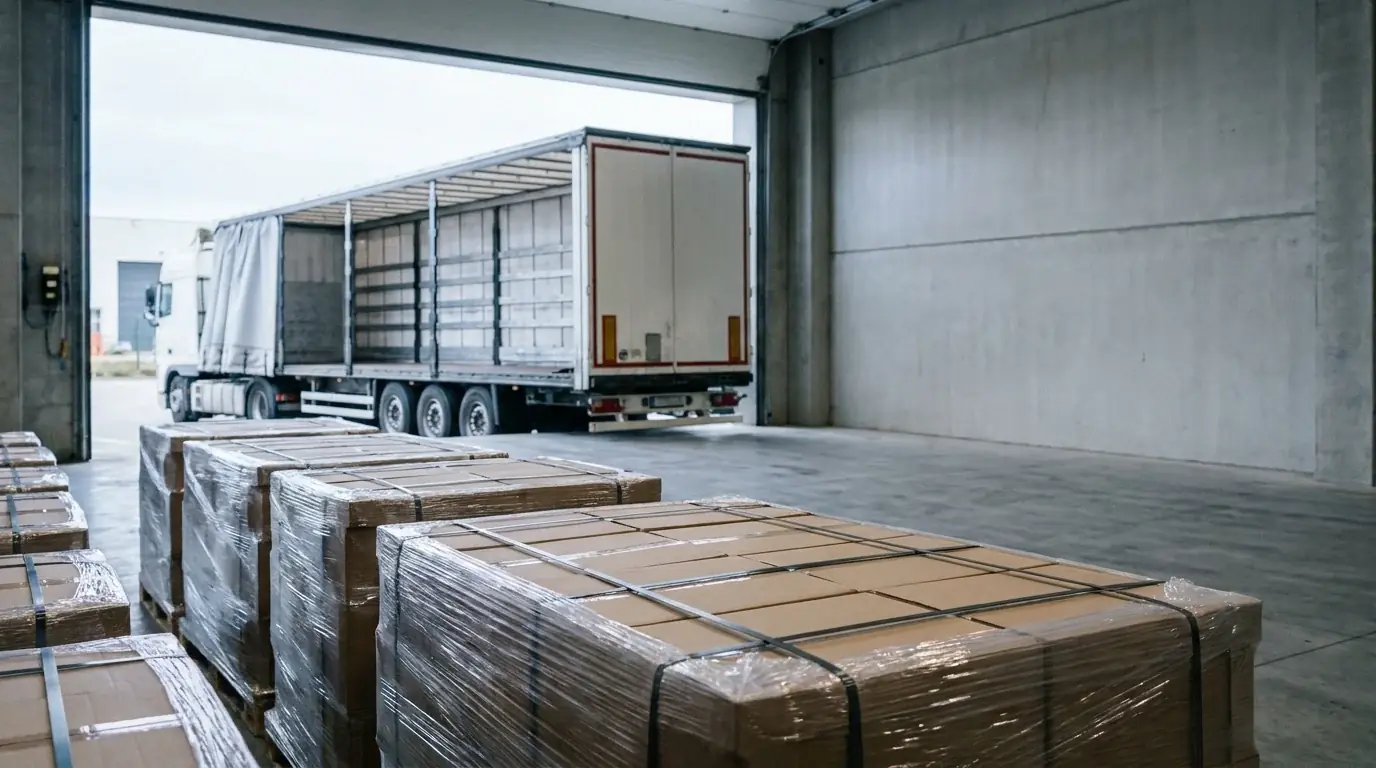
A euro pallet (1200 x 800 mm) counts as 0.4 LDM and a 1200 x 1000 mm pallet as 0.5 LDM in the carrier terms read for this guide, both from length x width / 2.4. Ten euro pallets are 4.0 LDM by that formula, and our planner's first layout for them uses the same 4.0 m. How a carrier treats stacking, crates and rounding is set in its own terms; three of them are quoted below, next to the results our planner gives for the same pallets.
LDM per pallet by footprint
| Footprint (mm) | Area (m²) | Formula LDM per pallet | Stated in the carrier terms read |
|---|---|---|---|
| 1200 x 800 (euro, EPAL 1) | 0.96 | 0.96 / 2.4 = 0.40 | 0.4 (DSV, Posti) |
| 1200 x 1000 (industrial, EPAL 2) | 1.20 | 1.20 / 2.4 = 0.50 | 0.5 (Posti, 100 x 120 cm "FIN pallet") |
| 1140 x 1140 | 1.30 | 1.2996 / 2.4 = 0.54 | not listed |
| 1200 x 1200 | 1.44 | 1.44 / 2.4 = 0.60 | not listed |
| 800 x 600 (half pallet) | 0.48 | 0.48 / 2.4 = 0.20 | 0.2 (Posti) |
1200 x 800 and 1200 x 1000 are in Table 1 of ISO 6780:2003 (iso.org) and 1140 x 1140 is in its Table 2 (square sizes); 1200 x 1200 is in neither. EPAL lists the euro pallet at 1200 x 800 x 144 mm and the EPAL 2 at 1200 x 1000 x 162 mm.
Euro pallets: formula against planner layout
Trailer 13.60 x 2.48 x 2.70 m, part-load mode (cargo packed from the headboard), each pallet 1.10 m high and 300 kg, rotation allowed. "2 high" means two layers of the same pallet, 2.20 m in total. The planner offers a main layout first and, where it differs, an alternative; the alternative column shows it (lengthwise rows of three unless marked "across").
| Pallets | Formula (N x 0.4) | Planner main, not stackable | Alternative, not stackable | Planner main, 2 high | Alternative, 2 high |
|---|---|---|---|---|---|
| 1 | 0.4 | 0.8 | 1.2 | 0.8 | 1.2 |
| 2 | 0.8 | 0.8 | 1.2 | 0.8 | 1.2 |
| 3 | 1.2 | 1.2 | 1.6 (across) | 0.8 | 1.2 |
| 4 | 1.6 | 1.6 | 2.4 | 0.8 | 1.2 |
| 5 | 2.0 | 2.4 | none | 1.2 | 1.6 (across) |
| 6 | 2.4 | 2.4 | none | 1.2 | 1.6 (across) |
| 7 | 2.8 | 3.2 | 3.6 | 1.6 | 2.4 |
| 8 | 3.2 | 3.2 | 3.6 | 1.6 | 2.4 |
| 9 | 3.6 | 3.6 | 4.0 (across) | 2.4 | none |
| 10 | 4.0 | 4.0 | 4.8 | 2.4 | 2.4 (across) |
| 12 | 4.8 | 4.8 | none | 2.4 | none |
| 14 | 5.6 | 5.6 | 6.0 | 3.2 | 3.6 |
| 16 | 6.4 | 6.4 | 7.2 | 3.2 | 3.6 |
| 18 | 7.2 | 7.2 | none | 3.6 | 4.0 (across) |
| 20 | 8.0 | 8.0 | 8.4 | 4.0 | 4.8 |
| 24 | 9.6 | 9.6 | none | 4.8 | none |
| 26 | 10.4 | 10.4 | 10.8 | 5.6 | 6.0 |
| 30 | 12.0 | 12.0 | none | 6.0 | 6.4 (across) |
| 33 | 13.2 | 13.2 | 13.6 (across) | 7.2 | 7.2 (across) |
| 34 | 13.6 | 13.6 | none | 7.2 | 7.2 (across) |
The formula works because a row of three lengthwise costs 1.2 / 3 = 0.4 m per pallet and a row of two turned costs 0.8 / 2 = 0.4 m, so any count from 2 up can be built from full rows at exactly 0.4 LDM each. The planner's main layout mixes the two orientations and reaches N x 0.4 for most counts: 10 pallets come out at 4.0 m. In these runs it stayed above the formula at 5 pallets (2.4 against 2.0) and 7 pallets (3.2 against 2.8), and a single pallet takes 0.8 m turned. The all-lengthwise alternative, three across in 1.2 m rows, is the layout to compare with if a carrier counts whole rows: 10 pallets that way are 4 rows and 4.8 m.
For two high, halve the count into floor positions first (rounded up) and apply 0.4 m each. The planner's main layout matches that for most counts but not all: 14 pallets are 7 positions and 2.8 LDM by formula, 3.2 m in the planner. A mixed pattern of turned and lengthwise rows still has to be secured and its axle loads checked.
The deck ceiling is 13.6 / 0.4 = 34 pallets, which the planner reaches by mixing orientations; three-across rows alone stop at 33 (11 x 1.2 = 13.2 m). The DSV LTL terms of May 2026 (dsv.com) give a maximum vehicle capacity of 33: "Maximumkapazität des Fahrzeugs: 33 Paletten (L x H x B 120x80x220cm Grundmaß) und 24 t." Plan for 33 unless the carrier confirms 34.
Other footprints, flat and 2 high
Same trailer, pallet height and weight; the figures are the planner's main layout. Two pallets fit across the deck for all three sizes.
| Pallets | 1200 x 1000 flat | 1200 x 1000 2 high | 1140 x 1140 flat | 1140 x 1140 2 high | 1200 x 1200 flat | 1200 x 1200 2 high |
|---|---|---|---|---|---|---|
| 2 | 1.00 | 1.00 | 1.14 | 1.14 | 1.20 | 1.20 |
| 4 | 2.00 | 1.00 | 2.28 | 1.14 | 2.40 | 1.20 |
| 6 | 3.00 | 2.00 | 3.42 | 2.28 | 3.60 | 2.40 |
| 8 | 4.00 | 2.00 | 4.56 | 2.28 | 4.80 | 2.40 |
| 10 | 5.00 | 3.00 | 5.70 | 3.42 | 6.00 | 3.60 |
| 12 | 6.00 | 3.00 | 6.84 | 3.42 | 7.20 | 3.60 |
| 16 | 8.00 | 4.00 | 9.12 | 4.56 | 9.60 | 4.80 |
| 20 | 10.00 | 5.00 | 11.40 | 5.70 | 12.00 | 6.00 |
| 22 | 11.00 | 6.00 | 12.54 | 6.84 | 13.20 | 7.20 |
- Capacity. The planner places at most 26 flat and 52 two high for 1200 x 1000, and 22 flat and 44 two high for both square sizes (euro: 34 and 68).
- 1200 x 1000 is 0.5 LDM per pallet in the planner, flat and per floor position two high: two pallets side by side (2 x 1.2 m = 2.4 m) fill a 1.0 m row. An odd count ends in a half-empty row. The planner's alternative turns them the other way, 1.2 m rows, which is longer (8 pallets flat: 4.8 m against 4.0 m).
- 1140 x 1140 is 0.54 LDM by formula but 0.57 in the planner (1.14 m per two pallets), because two across use only 2.28 m of the 2.48 m width and the row is as deep as the pallet.
Stackable or not: what the carrier terms say
Stacking changes the LDM only if the carrier accepts the stack. Three sets of terms:
| Carrier terms | What they say about stacking |
|---|---|
| DSV Road AB v29-2024 (dsv.com), international, 3.4.1 (c) | "The combined stack must not exceed 2.2 meters in height, and the weight must not exceed 1000 kilos for the stack to be considered stacked." The pallets must be stacked "by and at the consignor's place", be approved pallets and pass the whole chain without re-stacking. |
| Posti Freight, chargeable weight | Pallet metres apply "when the package height is over 1.3 meters or the length is over 5 meters or there is a stacking prohibition on the package or it has not been loaded onto a mechanically handled pallet". |
| Schenker Deutschland AG (dsv.com), June 2026, clause 13 (national) | Up to 5 non-stackable EPAL pallets or up to 2 LDM: the higher of volumetric and actual weight. From 2 LDM the LDM weight at 1,250 kg per LDM joins the comparison. |
The DSV condition can be tested directly. Two pallets of 1.10 m make exactly 2.20 m and two of 300 kg make 600 kg, inside both limits. A second layer at 1.15 m would make 2.30 m, so the stack would not count as stacked.
The Schenker clause in German: "Als frachtpflichtiges Gewicht von 1 bis 5 Stellplätzen oder 1 - 5 nicht stapelbaren EPAL-Paletten oder vergleichbare Paletten / Gitterboxen oder bis 2 Ldm oder 2.500 kg gilt das Maximum aus dem Kubikmeter Gewicht und dem tatsächlichen Gewicht." In English: for 1 to 5 pallet places, or 1 to 5 non-stackable EPAL pallets, or up to 2 LDM or 2,500 kg, the higher of the cubic-metre weight and the actual weight applies. The same clause sets a minimum of 250 kg per euro pallet and 125 kg per half pallet (80 x 60 cm).
Crates and long goods
The DSV international terms (dsv.com) (3.4.1 (e)) treat goods that are "difficult to stow" with a gap rule: "(the good's length in meter * the goods width in meter)/2.4 meters, if the space between the side wall of the carrier and the goods after loading is exceeding 80 cm. Otherwise the loading meter dimension is the same as the goods’ longest dimension in relation to the length of loading space."
On a 2.48 m deck:
- A 2.00 x 1.50 m crate with its 1.50 m side across the deck leaves 0.98 m beside it, over 0.80 m, so the formula applies: 2.00 x 1.50 / 2.4 = 1.25 LDM. The planner's main layout turns it the other way, 2.00 m across, which uses 1.5 m of deck but leaves 0.48 m, and the gap rule then counts 2.0 LDM; its alternative keeps the 1.50 m side across (2.0 m of deck).
- A 2.00 x 2.00 m crate leaves 0.48 m whichever way it is turned, so the longest dimension counts: 2.0 LDM, against 1.67 by the formula alone. The planner also uses 2.0 m.
For packages of 6 m or more, clause 3.4.1 (d) switches to width bands; 81 to 120 cm of width is "meter of length x 1.2/2.4". The carrier's example is "6 m long 90 cm wide = 6 x (1.2/2.4) = 3 loading meters", against 2.25 LDM by the plain formula (6 x 0.9 / 2.4). The planner shows one 6.0 x 0.9 m piece as 6.0 m of deck and two side by side as the same 6.0 m, which is 3.0 each and matches the carrier's band once a second piece shares the row.
Rounding in the terms read
- DSV 3.4.1 (d): "The dimensions are rounded up to one decimal place." The sentence closes the clause on packages of 6 m or more. Applied to a 1.14 x 1.14 m pallet it would make 1.2 x 1.2 m and 0.60 LDM instead of 0.54; the terms do not say it applies there, so ask.
- DSV 3.4.2: minimum invoicing is calculated after 200 kg, and "For consignments with weight exceeding 200 kilos the effective weight is rounded up to nearest whole 100 kilos."
- Posti: "Length x width/2.4 m = pallet meter." Its euro pallet example "fills 0.4 pallet meters of the cargo space, the chargeable weight is 740 kg", which is 0.4 x 1,850 kg.
- Schenker national: euro pallet minimum 250 kg regardless of the LDM figure (clause 13).
None of the three sets a fixed step such as 0.5 LDM for rounding the loading metres themselves. If a quote rounds LDM up, ask for the rule in writing.
Worked examples
10 euro pallets, not stackable, 300 kg each (3,000 kg). Formula: 10 x 0.4 = 4.0 LDM, and the planner's main layout, mixing lengthwise and turned rows, also uses 4.0 m. Its alternative is 4 lengthwise rows of three: 10 / 3 = 3.33, rounded up to 4 rows, 4 x 1.2 = 4.8 m. At the Schenker national factor of 1,250 kg per LDM, 4.0 LDM is 5,000 kg and 4.8 LDM is 6,000 kg, both above the actual 3,000 kg, so if a carrier counts whole lengthwise rows the 0.8 LDM difference is 1,000 kg of chargeable weight. You can enter your own load in the 3D load planner to see the layout and axle loads.
14 euro pallets, 2 high, 1.10 m each. Floor positions: 14 / 2 = 7. Formula: 7 x 0.4 = 2.8 LDM. The planner's main layout uses 3.2 m; its lengthwise alternative, 7 / 3 = 2.33 rounded up to 3 rows, uses 3.6 m. The stack is 2.20 m and 600 kg, so the DSV stacking condition holds.
One 2.00 x 1.50 m crate and one 2.00 x 2.00 m crate, each 1.00 m high and 500 kg, not stackable, rotation allowed. With the smaller crate 1.50 m across, the clause gives 1.25 + 2.00 = 3.25 LDM. The planner's main layout placed both 2.00 m across, the square crate first, over 3.5 m of deck (its alternative uses 4.0 m); on that layout both crates leave 0.48 m, so a carrier applying 3.4.1 (e) would count 2.0 + 2.0 = 4.0 LDM.
Which figure to quote
For two or more euro pallets, flat, quote N x 0.4 and confirm it in the booking: it is what the carrier terms read here state per pallet, and a mix of turned and lengthwise rows reaches it, as the planner's main layout shows for most counts. A carrier may still bill by its own rule, for example whole lengthwise rows, so ask. For 1200 x 1000, 1140 x 1140 and 1200 x 1200 pallets the planner and the row arithmetic agree, so quote the planner's figure. Quote a 2-high figure only when the consignor will stack at loading and the stack meets the carrier's conditions (under DSV, 2.2 m and 1,000 kg per stack). Once you have the LDM, the FTL vs LTL guide shows when a whole truck is the cheaper booking.
Sources
- DSV Road AB, Transport Terms & Conditions, Version 29-2024 (dsv.com), international terms 3.4.1 (b) to (e) and 3.4.2.
- Schenker Deutschland AG (DSV), Vertragsbedingungen, Stand Juni 2026 (dsv.com), clause 13.
- Posti, Freight instructions, chargeable weight (page undated).
- DSV, Nutzungsbedingungen DSV LTL, Mai 2026 (dsv.com), clause 1, vehicle capacity.
- EPAL, euro pallet and EPAL 2 specifications.
- ISO 6780:2003, Tables 1 and 2 (iso.org).
- Planner figures: LDM Calculator truck planner, November 2026. These are the planner's own results, not a carrier tariff or a legal limit.